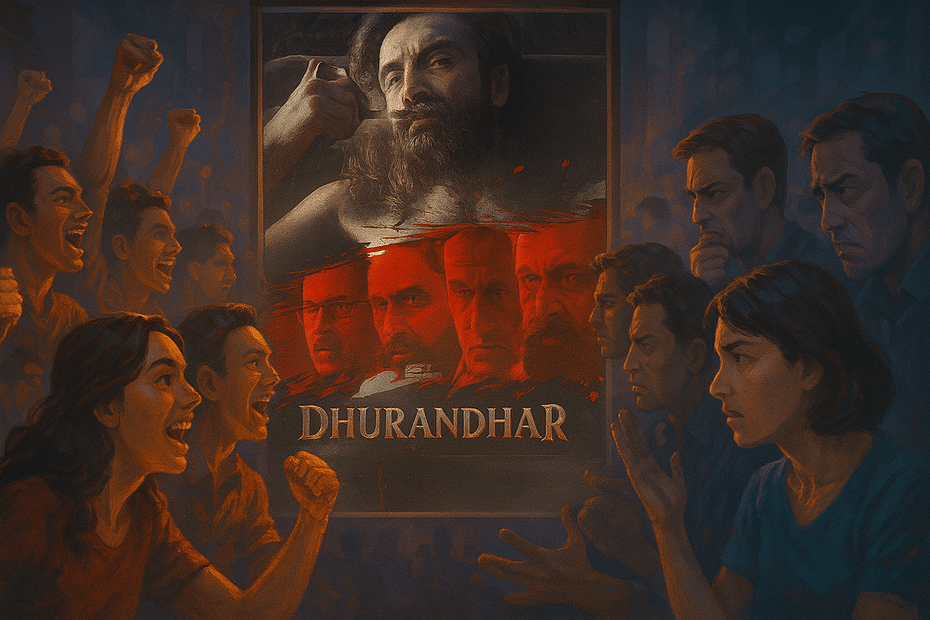
In the world of Indian cinema, few films spark curiosity even before their release. “Dhurandhar” has unexpectedly become one of those rare names—spoken about in living rooms, debated across social media, examined in entertainment circles, and interpreted in more ways than one. What follows is a neutral, story-style exploration of what is happening around the film, how conversations have formed, and why it has become a cultural talking point.
A Title That Arrived Before Its Story Did
“Dhurandhar” did not emerge quietly. The very name entered the public space with an air of mystique. No elaborate posters, no traditional promotional rollouts—just a title circulating online, attached to big expectations and bigger guesses.
For weeks, audiences wondered: What kind of film could this be? An action-packed political thriller? A biographical drama? A period epic?
Nobody seemed to know for certain, but the speculations spread faster than official updates.
This uncertainty became the film’s first wave of attention. And what happens when a film arrives with more questions than answers? People create their own stories around it.
A Film That Turned Into a Riddle
The first thing that drew mass attention was the secrecy. Cinema fans are used to teasers, leaks, and interviews—”Dhurandhar” offered none of that. Instead, it appeared almost like a riddle placed in the center of India’s digital chatter.
The lack of information created its own kind of excitement:
- Some assumed the film would be a commentary on leadership.
- Others believed it would portray a complex fictional character.
- A few said it might be a satire.
- Many insisted it was a mass entertainer with an emotional core.
Yet nothing was confirmed.
A film still shrouded in ambiguity somehow managed to dominate discussions. In a world where information flows endlessly, the absence of information became the hook.
The Social Media Whirlpool
If the offline world was whispering about the film, the online world was shouting.
Debates, memes, prediction posts, and opinion threads started forming every day. Influencers, cinema pages, and fan clubs began dissecting whatever little they could find—be it a rumored cast list, a possible release month, or a symbolic poster.
What was interesting, however, was how varied the tone was. Some conversations were hopeful, some analytical, some humorous. The film became a canvas for people to project their interpretations.
In a way, “Dhurandhar” became less of a movie and more of a cultural moment. Even before release, it was already a talking point.
A Story of Expectations Instead of Plot
Most pre-release films build excitement with trailers. “Dhurandhar” built excitement through silence.
The question the public kept revisiting was: What is the film trying to say?
Even without knowing the plot, viewers formed expectations. This is where the story around the film becomes more interesting than the film itself—at least for now.
As a neutral observer, what becomes clear is this: people expect “Dhurandhar” to be more than entertainment. They expect it to reflect something about society, personality, ambition, confrontation, or ideology. Whether the film intends to do any of this is unknown, but the audience has already imagined it into existence.
This ability of a film to inspire its own mythology without revealing its content is rare—and telling.
The Emotional Atmosphere Around the Film
The public mood surrounding “Dhurandhar” isn’t uniform. It feels layered.
1. Excitement
Many viewers simply love the buildup. They enjoy anticipating a film without knowing where it will lead. The mystery feels refreshing.
2. Curiosity
Curiosity is perhaps the strongest emotion here. People want answers—about the narrative, about the cast, about the message. They want to understand why this film has such an aura of secrecy.
3. Concern
Some are cautious. They wonder whether the hype is overshadowing the actual content. They ask whether the film will match expectations or struggle under their weight.
4. Speculation
This emotion fuels most of the conversation. In the absence of official statements, speculations fill the vacuum.
The atmosphere is a blend of all four—and that blend is what keeps “Dhurandhar” alive in daily conversation.
The Industry’s Quiet Watchfulness
Film industries rarely respond openly to speculation, and this situation is no different. But there is a sense that industry insiders are paying attention.
Producers, directors, actors, and marketing teams have all witnessed how quickly the “Dhurandhar” narrative has expanded. They see how a simple title has created a movement of interest.
Some production houses may be studying the model:
What if silence is a marketing strategy?
With audiences growing tired of over-promotions, “Dhurandhar” feels like a return to old-school intrigue, where audiences enter theatres with genuine curiosity rather than full plot knowledge.
Whether intentional or accidental, the film has sparked a conversation among creators as well.
The Symbolism Discussions
One of the most unique aspects of this film’s atmosphere is how people started attaching symbolic meaning to it.
Some say the title implies strength. Others associate it with resilience or strategy. Many interpret it through the lenses of history, literature, or cinema archetypes.
Again, none of this is officially confirmed. Yet the symbolic interpretations are part of the story because they reflect how people relate to the unknown.
This shows something important about audiences: they love building meaning.
And “Dhurandhar” has provided them with a fertile ground to build it on.
A Neutral Assessment of the Hype
From an observer’s point of view, the situation presents a fascinating case study.
Why did this film generate such discussion?
Several reasons emerge:
- Mystery works. In a predictable world, uncertainty captures attention.
- People enjoy collective speculation. It creates community.
- The title itself is strong. It suggests power, conflict, and complexity.
- Digital platforms amplify curiosity. A small spark becomes a wildfire.
- Audiences crave something new. Whether or not the film delivers that remains to be seen.
Is the hype positive or negative?
It’s simply energy.
A film gaining attention before release isn’t good or bad by default. It depends on how the story unfolds once the film finally introduces itself.
Right now, the attention is organic and widespread—a sign that people are ready to listen.
The Waiting Game: What Happens Next?
The future of the “Dhurandhar” narrative depends on the film’s next steps.
When the first official poster drops, it will shape the conversation.
When the teaser arrives, it will direct expectations.
When the film releases, it will close the chapter of ambiguity and open the chapter of interpretation.
Until then, the public continues to wait—and waiting has become its own experience.
In many ways, India loves a good mystery. “Dhurandhar” has become one.
Why This Story Matters Beyond the Movie
At first glance, the story around “Dhurandhar” seems like a typical pre-release buzz phenomenon. But look closer, and it represents something larger.
It reflects how storytelling has evolved. Films are no longer just cinematic products. They are cultural events shaped by the audience, not only by the makers.
The “Dhurandhar” conversation shows that:
- Audiences want engagement.
- They enjoy decoding narratives.
- They participate in building meaning.
- They shape the anticipation as much as the creators.
This is storytelling in the digital age—two-way, unpredictable, and often more exciting than the story itself.
Final Reflection: A Story Still Being Written
“Dhurandhar” is not just a film right now. It’s a moment of collective curiosity. It is a story that the public is writing in real time without seeing a single frame of the movie.
As a neutral observer, the most fascinating part is not what the film contains—but how people respond to what they don’t yet know.
Whether the film becomes a blockbuster, a critical favorite, or a quiet release, the story of how it captured attention will remain an interesting chapter in modern Indian cinema.
For now, the narrative continues to unfold. And everyone is watching.
This article is written as a neutral, observational storytelling blog, without endorsing or opposing any viewpoints about the film, and without presenting any harmful or sensitive assumptions. It focuses solely on public conversations, perceptions, and the cultural atmosphere surrounding the movie.