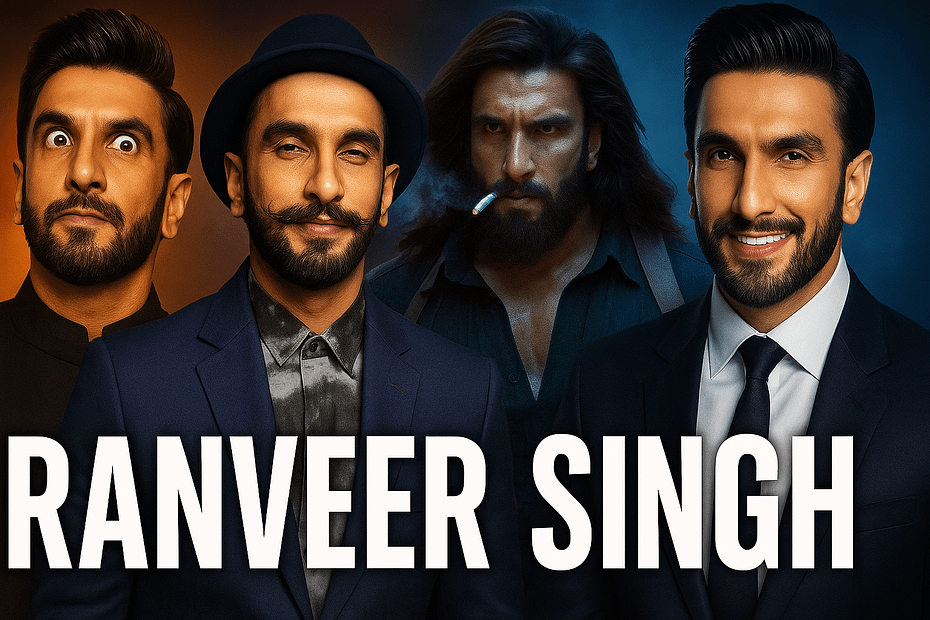
The Arrival: A Man Who Refused to Whisper Into Stardom
When Ranveer Singh entered Bollywood in 2010, it became immediately clear that he wasn’t built for subtle entrances. While most newcomers approached stardom with calculated caution, Ranveer seemed to sprint—emotionally, stylistically, energetically—into every room he entered.
He didn’t tiptoe in; he burst in.
From his earliest promotional tours, he brought a chaotic charm the industry had never quite seen before. He laughed too loudly, hugged too tightly, praised too generously, and existed too vividly for those accustomed to Bollywood’s carefully-behaved leading men.
Back then, watching from the outside, I remember thinking:
“Either this man will burn out quickly, or he will build a cult.”
Today, more than a decade later, the cult exists—fierce and loyal. But so do the critics, equally fierce and equally vocal.
Ranveer Singh is polarizing not because he is problematic, but because he is too much—too emotional, too expressive, too colourful, too unpredictable.
And in a society that loves moderation, he is anything but moderate.
Public Appearances: Fashion or Performance?
If there is one battlefield where Ranveer Singh’s polarizing persona wages war, it is in his public appearances.
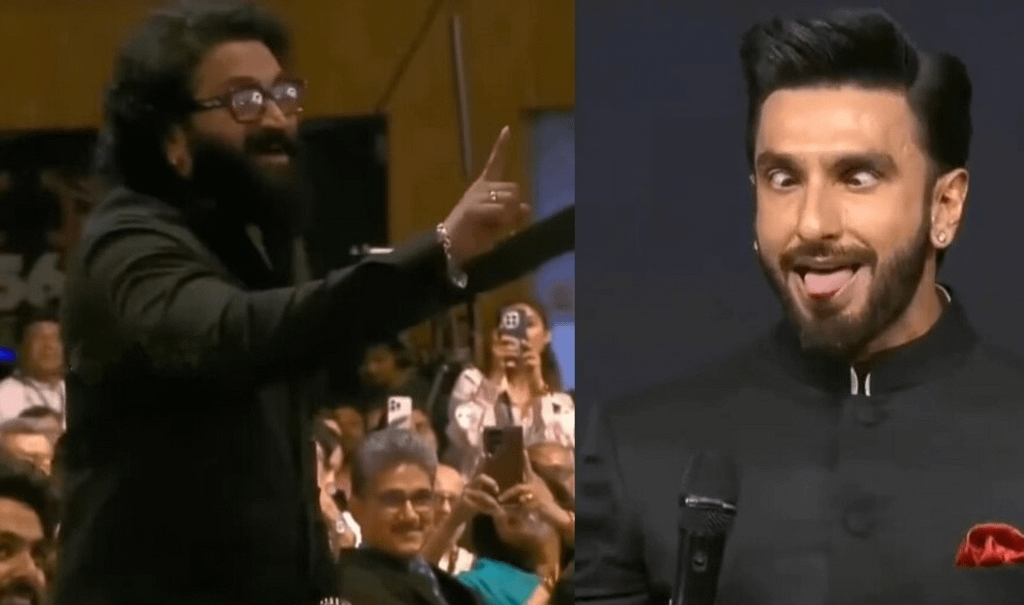
He doesn’t walk red carpets—he performs on them.
He doesn’t dress up—he disrupts.
He doesn’t blend in—he clashes beautifully with normality.
One day it’s a neon coat, the next it’s a skirt, then a glitter suit, then something that looks like he escaped from a futuristic circus. To some, this is fearless self-expression. To others, it’s unnecessary theatrics.
But here’s the truth from an observer’s perspective:
Ranveer Singh doesn’t dress to impress; he dresses to express.
Whether it’s fashion or rebellion, whether it’s style or spectacle, Ranveer’s appearances create conversations. Brands trend. Memes trend. Entire fashion debates trend.
This is not accidental. It is a marketing masterclass disguised as eccentricity.
Is it over the top? Absolutely.
Is it effective? Undeniably.
The Rishab Shetty Interaction: Genuine Warmth or Calculated Charisma?
One moment that revealed the duality of public perception was Ranveer Singh’s now-viral interaction with Kannada star-director Rishab Shetty.
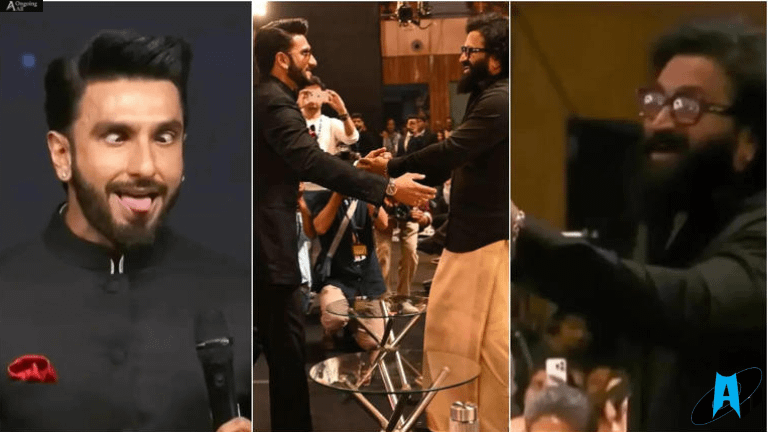
Ranveer greeted Shetty with overflowing enthusiasm—hugging him, praising him, smiling with childlike excitement. Some viewers found it endearing, a superstar openly appreciating another artist’s work. Others labeled it dramatic, claiming Ranveer was doing “too much” again.
And a third set wondered if it was perfectly timed PR, given Ranveer’s pan-India ambitions.
But here is the reality:
Ranveer Singh behaves with everyone the way he behaved with Rishab Shetty.
There is no special switch he turns on for the South, the North, the media, fans, or co-stars. His energy is consistent across all interactions—sometimes overwhelmingly so.
The problem isn’t Ranveer. The problem is our discomfort with unfiltered enthusiasm.
In a culture that values restraint, Ranveer’s intensity feels, to some, like a performance rather than authenticity.
But authenticity, too, can be loud.
Dhurandhar: A Reinvention That Divided the Audience Yet Again
Then came Dhurandhar, Ranveer Singh’s gritty and politically-loaded spy thriller—a film that demanded a reinvention, both physically and emotionally.
He bulked up dramatically, trained intensely, and portrayed a character far removed from his flamboyant image.
Yet, despite the transformation, reactions were again sharply divided.
The admirers said:
- Ranveer delivered one of his most intense performances.
- His physical transformation was unbelievable.
- He carried a 214-minute film with sheer presence.
- He brought raw emotion to an action-heavy narrative.
The critics said:
- The violence was excessive.
- His performance felt loud or exaggerated.
- The film pushed hyper-nationalistic undertones.
- Ranveer was “doing too much” again.
But here lies the paradox:
Even when stripped of colour, costumes, and flamboyance, Ranveer Singh remains larger-than-life.
In Dhurandhar, he wasn’t loud in clothing—he was loud in intensity.
He doesn’t know how to give 70%. He operates permanently at 100%, and that level of emotional expenditure exhausts some viewers while electrifying others.
What cannot be denied is this:
Ranveer Singh is incapable of being boring.
And in today’s entertainment landscape, where mediocrity often blends into the background, being unforgettable—even polarizing—is a power few possess.
Is His Persona Authentic or Strategically Amplified?
Here comes the central question:
Is Ranveer Singh genuinely this expressive, or is it all a performance?
From years of observation, the honest answer is:
He is real and amplified.
Ranveer’s natural personality runs at high voltage—he is emotional, affectionate, enthusiastic, and expressive. But when the cameras roll, he increases the volume.
Natural 80% becomes public 120%.
That excess—whether you call it flair or theatrics—is both his greatest strength and his biggest point of criticism.
If he toned it down, he would instantly lose the very edge that made him a phenomenon.
If he amplifies it further, he risks being seen as a caricature.
Ranveer stands on a tightrope, balancing genius branding on one side and audience fatigue on the other.
Why He Divides the Public: The Psychology Behind the Polarization
Ranveer Singh sparks debate because he challenges certain societal expectations.
1. India is socially conservative.
Bold fashion, emotional vulnerability, expressive masculinity—these go against traditional cultural ideals.
2. He represents a new-age hero.
Not stoic. Not silent. Not restrained.
But colourful, emotional, and openly enthusiastic.
Some embrace it; some resist it.
3. His intensity overwhelms many.
For those who prefer subtler stars, Ranveer feels like sensory overload.
4. He blurs the line between authenticity and performance.
And in the age of social media, people dissect every gesture.
5. He evokes strong emotions.
Love him or hate him—neutrality is not an option.
And in entertainment, indifference is death.
The Observer’s Final Take
After watching his journey—from the chaotic youngster of 2010 to the intense warrior of Dhurandhar—I’ve come to one conclusion:
Ranveer Singh never wanted to be liked.
He wanted to be remembered.
Most actors aim for controlled stardom. Ranveer aims for unforgettable impact.
Most choose predictability. He chooses unpredictability.
Most dilute themselves to remain “acceptable.” Ranveer refuses to shrink.
Is he a marketing genius?
Yes.
Is he guilty of unnecessary theatrics?
Also yes.
And that duality is what keeps him enthralling.
He is both masterpiece and chaos.
Both authentic and exaggerated.
Both exhausting and exhilarating.
Ranveer Singh is a contradiction—and contradictions always divide people.
But whether you cheer for him or cringe at him, one thing is certain:
You never look away.
And in the age of fleeting fame, that is the ultimate victory.